

Table of Contents
- What Bulk DTF Prints Offer Your Business
- Custom Gang Sheets and Ready-to-Press Solutions
- Bulk DTF Printing Turnaround Time and Production Capacity
- Wholesale DTF Transfer Pricing and Volume Discounts
- File Requirements and Print Quality Standards
- Heat Press Application and Durability Testing
- Troubleshooting Common Transfer Failures
- Why Bulk DTF Prints Eliminate Equipment Investment
- Frequently Asked Questions
Last Updated: September 27, 2026
What Bulk DTF Prints Offer Your Business
Bulk DTF prints represent a fundamental shift in how custom apparel businesses scale production. Direct-to-film transfer technology eliminates the need to own and maintain expensive equipment while delivering vibrant, full-color designs on demand. For business owners managing multiple orders simultaneously, bulk DTF prints solve the core problem: how to handle volume without capital investment or quality compromise.
The key advantage: outsourcing bulk DTF printing converts fixed costs (equipment, maintenance, floor space) into variable costs tied directly to output, ideal for smaller or seasonal businesses that can't justify a full setup.
Custom Gang Sheets and Ready-to-Press Solutions
A gang sheet consolidates multiple designs onto a single print run, cutting production time and per-unit costs by combining artwork files on one sheet instead of running individual transfers.
Gang sheets excel for businesses with varied orders or seasonal lines, allowing you to mix designs, colors, and quantities without minimum order penalties.
Ready-to-press transfers arrive cut, weeded, and prepared for immediate heat press application, no setup required or learning curve.
You provide print-ready artwork in correct resolution and color profile; the production team handles tiling, layout optimization, and consistency.
Bulk DTF Printing Turnaround Time and Production Capacity
Bulk DTF prints typically ship in 3-7 business days; simpler orders move faster, complex gang sheets may take longer.
Production capacity varies by supplier. Limited capacity can strain peak seasons or rush orders.
Choose suppliers who publish exact turnaround timelines and explain what happens if deadlines slip, avoid vague "fast shipping" promises.
Order with at least a one-week buffer to protect against delays and allow time for quality troubleshooting before customer delivery.
Wholesale DTF Transfer Pricing and Volume Discounts
Bulk DTF pricing depends on order quantity, design complexity, rush status, and delivery method. Understanding your cost-per-impression is critical for profitability.
Tiered Pricing Structure and Volume Breakpoints
Most suppliers offer tiered pricing at various unit breakpoints. Pricing depends on order quantity, design complexity, rush status, and delivery method.
Largest per-unit savings may occur at certain volume breakpoints. Know your volume tier to decide whether to consolidate or split orders.
Design Complexity and Rush Surcharges
Pricing also varies by design complexity, color count, gang sheet setup fees, rush surcharges (typically 25-50%), and shipping method. Ask suppliers to itemize these. Rush orders are expensive; plan ahead for standard 3-7 day turnaround to save significantly.
Cost-Per-Impression Calculator for ROI Analysis
Calculate cost-per-impression: (Transfer cost + shipping per unit) ÷ Quantity. Example: 250 transfers at $1.50 + $0.20 shipping = $1.70 per transfer. If you sell garments for $15 with $6 COGS, your $9 margin minus $1.70 transfer cost leaves $7.30 (49% gross margin).
Compare against in-house DTF, screen printing, or outsourced DTF. Outsourced bulk DTF can deliver strong ROI for small to mid-size businesses by eliminating capital risk while maintaining flexibility.
Evaluating Supplier Pricing Transparency
Prioritize suppliers who publish pricing upfront, provide itemized quotes (transfer cost, setup, shipping, surcharges), explain volume breakpoints clearly, offer price matching, and disclose rush surcharges upfront. Pricing transparency signals quality and service confidence.
Negotiating Better Pricing for Recurring Orders
For regular orders, negotiate annual volume discounts rather than per-order pricing. Approach suppliers with projected annual volume, order frequency, typical order size, and commitment period. Many offer loyalty pricing for predictable, recurring revenue, don't assume published pricing is final.
File Requirements and Print Quality Standards
Print quality starts with file preparation: 300 DPI minimum, CMYK color profile, PDF/PNG/TIFF format. A 72 DPI file looks acceptable on screen but produces pixelated transfers. Use 300 DPI minimum for designs under 6 inches; larger designs can use 150 DPI but 300 DPI is safer.
Use CMYK color profile (not RGB, which shifts colors when converted). Vector graphics (AI, EPS, SVG) are ideal for logos; rasterized images (JPG, PNG) lock you into specific resolution.
Heat Press Application and Durability Testing
Fabric-Specific Application Parameters
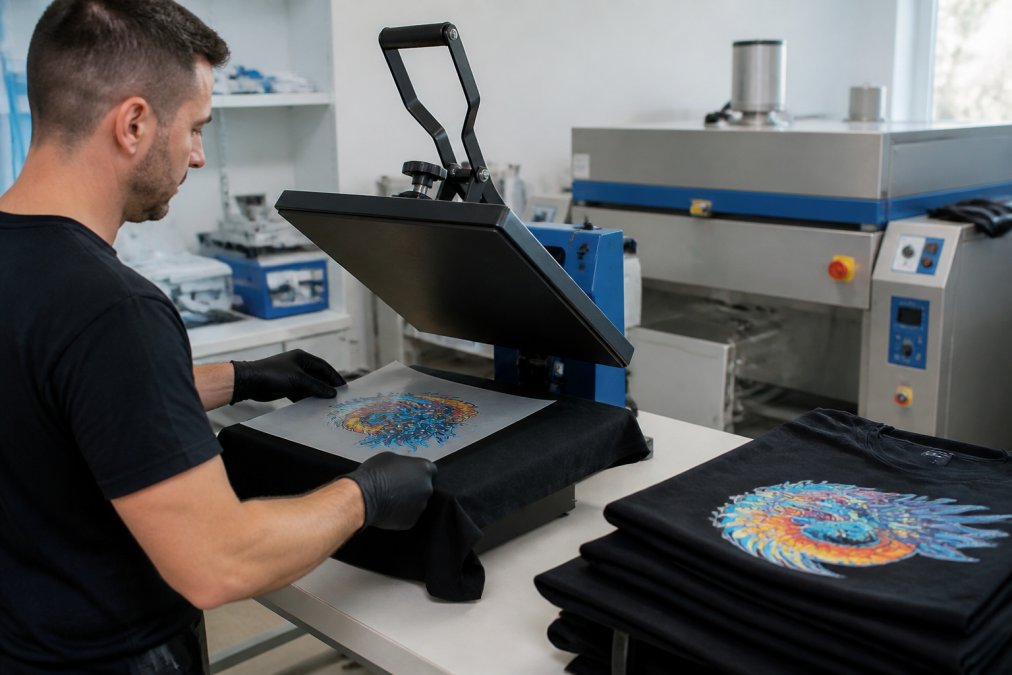
Cotton and Cotton-Rich Blends (85%+ cotton) Standard DTF transfers on 100% cotton typically require 330-350°F with medium pressure (3-4 bars on most heat presses) for 10-15 seconds. The adhesive powder bonds well to cotton fibers at this temperature range. Use hot peel: remove the backing film immediately while the transfer is still warm. Waiting too long allows the adhesive to set unevenly, risking incomplete adhesion on edges.
Heat Press Calibration and Verification
Many heat presses drift over time, running 10-30°F hotter or cooler than the dial indicates. This is the single most common cause of transfer failure that users can control. Before applying any production batch, verify your actual temperature using an infrared thermometer or temperature gun. Place it on the lower platen (the surface that contacts the garment) and press down as if applying a transfer. Record the reading.
Dwell Time and Peel Method Decision Tree
If your transfer peels away immediately or within 1-3 washes:
- Check heat press temperature first (use a temperature gun)
- Verify pressure is medium (3-4 bars)
- Confirm dwell time matches fabric type (see table above)
- If all settings are correct, the issue is likely the transfer quality itself; request a reprint from your supplier
If edges curl or adhesive residue remains on the garment:
- You're likely using the wrong peel method for your fabric
- Cotton and blends: try hot peel if you've been cold peeling, or vice versa
- Polyester: always cold peel; hot peel causes adhesive to set unevenly
- Wait the full cool-down time (30-60 seconds for cold peel) before peeling
If the design appears faded or colors are muted:
- This usually indicates insufficient pressure or dwell time
- Increase pressure by 0.5 bars and dwell time by 2-3 seconds
- Test on a sample before adjusting production
- If the issue persists, check your file's color profile (should be CMYK, not RGB)
Durability Testing Protocol
Quality DTF transfers should withstand 30+ wash cycles without significant fading, cracking, or adhesion failure. Poor transfers fail after 5-10 washes. When evaluating a new supplier or testing a new fabric, follow this protocol:
- Apply transfers to at least 3 sample garments using your standard heat press settings
- Wash samples using standard consumer settings: warm water, gentle cycle, mild detergent (no bleach)
-
Inspect after 10, 20, and 30 wash cycles for:
- Color fading or shifting
- Cracking or peeling at edges
- Loss of adhesion in high-stress areas (seams, collar)
- Adhesive residue or tackiness
- Document results with photos and notes on any visible degradation
- Compare against your durability standards before committing to large orders
Troubleshooting Common Transfer Failures
Transfer failures fall into three categories: adhesion (peeling during or after application), color issues, and durability failures. Adhesion failure usually indicates incorrect heat press temperature, insufficient pressure, or wrong peel timing. Check calibration first with a temperature gun, many presses drift 10-30°F from dial setting.
Why Bulk DTF Prints Eliminate Equipment Investment
DTF equipment costs mid-five to six figures plus ongoing inks, adhesive, maintenance, and repairs. For variable-demand businesses, this investment sits idle during slow periods and bottlenecks during peaks. Outsourcing bulk DTF prints flips this: you pay only for what you produce.
| Factor | Consideration | Impact |
|---|---|---|
| File Preparation | 300 DPI minimum, CMYK color profile | Prevents blurry or color-shifted transfers |
| Gang Sheets | Consolidates multiple designs on one run | Reduces waste and per-unit costs |
| Heat Press Settings | 330-350°F, 10-15 seconds, correct peel method | Determines adhesion quality and durability |
| Turnaround Time | 3-7 business days depending on complexity | Affects customer delivery commitments |
| Volume Discounts | Tiered pricing at 100, 250, 500, 1000+ units | Improves margins on larger orders |
| Durability | 30+ wash cycles without significant fading | Reduces customer complaints and returns |
Frequently Asked Questions
What makes bulk DTF prints more cost-effective than screen printing or other decoration methods?
Bulk DTF prints eliminate the need to purchase and maintain direct-to-film equipment, which costs thousands of dollars. You pay only for the transfers you order, with no setup fees or minimum equipment investment. Pricing depends on quantity, order dates, and delivery speed, contact Mirage DTF Transfers for current pricing. This model works especially well for shops handling variable order volumes or seasonal demand spikes without committing to permanent production infrastructure.
How do I ensure color accuracy and fine detail reproduction in my bulk DTF orders?
Submit print-ready files in CMYK color profile with at least 300 DPI resolution to maintain crisp details on small logos and intricate designs. Gang sheet preparation allows you to nest multiple designs on one sheet, maximizing efficiency while preserving individual design quality. Before placing large orders, request a sample or proof to verify color accuracy and detail reproduction matches your digital files. Quality control processes at professional providers aim to catch banding issues, debris in adhesive, and color shifts before shipment.
What is the typical turnaround time for bulk DTF printing orders?
Bulk DTF printing turnaround time varies based on order volume and current production capacity. Many providers may offer expedited options for rush jobs. Confirm specific turnaround times and any guarantees with your supplier before placing orders, especially if you have tight deadlines with your end customers. Reliable turnaround is critical to maintaining your reputation and customer satisfaction.
Can I order bulk DTF prints in small quantities if I run a solo operation?
Yes, bulk DTF prints work at any scale, you don't need to be a large shop to benefit. Wholesale DTF transfer pricing typically includes volume discounts, but no-minimum ordering allows sole proprietors and small teams to test new designs and manage inventory without waste. Start with smaller orders to validate designs and quality, then scale up as demand grows. This flexibility makes bulk DTF printing ideal for independent decorators and side-business operators.