

Table of Contents
- What Is DTF Printing and How It Works for Promotional Products
- Best Promotional Product Ideas for DTF Transfers
- Understanding DTF Printing Cost and Pricing Factors
- DTF vs. Screen Printing: Which Method Wins for Your Business
- DTF Printing Disadvantages and How to Avoid Them
- Designing and Preparing Artwork for DTF Transfers
- Applying DTF Transfers: Press Settings and Best Practices
- Frequently Asked Questions
Last Updated: October 9, 2026
What Is DTF Printing and How It Works for Promotional Products
Direct-to-film (DTF) printing is a transfer method that applies full-color designs directly onto fabric using heat and pressure, making it an excellent choice for dtf printing for promotional products. Unlike traditional screen printing, DTF printing doesn't require separate screens for each color.
Mirage DTF Transfers provides high-quality direct-to-film transfer solutions for your printing needs. The process works by printing water-based inks onto PET film, applying adhesive powder, and curing the design before heat-pressing it onto fabric. The result is a vibrant, durable print that works on cotton, polyester, and blended materials.
The DTF Transfer Process: From Design to Heat Press
The workflow breaks into four clear steps. First, your design gets printed onto transfer film using a DTF printer. Second, adhesive powder is applied while the ink is still wet, then the film is cured in an oven or dryer.
Each step matters for quality. If the film isn't cured properly, the adhesive won't bond. If you press at the wrong temperature, the transfer either won't stick or the fabric melts.
The beauty of DTF transfers is flexibility. You can produce one shirt or one thousand without changing your setup. Just design, print, press, and ship.
Materials and Fabric Compatibility
DTF transfers work on most common fabrics. Cotton absorbs the adhesive well and produces sharp prints. Polyester also works, though some heat-sensitive synthetics can shrink if you overheat them. Blended fabrics (cotton-poly mixes) are ideal because they handle heat better than 100% cotton and hold detail better than pure polyester.
Dark fabrics need a white underbase to show colors accurately. Light fabrics print directly without an underbase. This matters for your design choices and production planning.
Avoid printing on heavily textured fabrics like terry cloth or corduroy. The uneven surface prevents the transfer from making full contact with the fabric, leaving gaps and weak adhesion.
Best Promotional Product Ideas for DTF Transfers
DTF printing shines when you need vibrant, detailed graphics on finished products. The method handles full-color artwork with no setup fees, making it perfect for branded merchandise campaigns.
Apparel: T-Shirts, Hoodies, and Custom Uniforms
T-shirts are the obvious choice, and they remain the strongest use case for DTF transfers. A single-color screen print costs less per unit at high volume, but DTF wins when you need custom designs, limited runs, or color variety.
Hoodies present a challenge because the fabric is thicker and heavier. The transfer needs more pressure and longer dwell time to bond properly. Jersey designs work well too.
The real advantage: you can offer customers custom apparel without bulk minimums. A small business ordering 12 branded t-shirts for employees gets the same quality as someone ordering 500.
Accessories: Hats, Caps, and Tote Bags
Hats and caps present a different challenge. The curved surface and structured fabric require careful pressing to avoid wrinkles and gaps. Tote bags work beautifully because they're flat and made from canvas or cotton, which accept transfers readily.
Promotional products like branded tote bags, hats, and caps create lasting brand visibility. A customer carries your branded tote bag for years. Every time they use it, your logo shows.
Caps and hats need custom fixtures or careful hand-pressing to ensure even pressure across the curved surface. Many producers outsource this work rather than invest in specialized equipment.
Understanding DTF Printing Cost and Pricing Factors
Cost depends on several variables. Larger transfers cost more because they use more film and ink. Complex designs with many colors cost the same as simple designs (no per-color surcharge like screen printing). Quantity affects per-unit cost, but DTF has no setup fees, so small orders stay affordable.
What Affects Transfer Pricing
Film size is the biggest cost driver. A full-chest design on a large transfer film costs more than a small logo. Ink usage scales with design area, not color count. A five-color design costs the same to print as a single-color design if both fill the same space.
Turnaround time matters. Rush orders may cost more. Standard turnaround (usually 5-10 business days) costs less than next-day production.
Material compatibility adds cost in some cases. Designs for dark fabrics need a white underbase layer, which requires an extra press cycle or a special white-capable DTF printer. This increases production time and cost.
Quantity Planning and Turnaround Time
Small orders (1-50 units) make sense for DTF because there's no per-design setup fee. A promotional product distributor can fulfill custom orders without forcing customers to buy 100 minimum units. This flexibility opens new market segments.
Turnaround time typically runs 5-10 business days from order to shipment. Rush options exist but cost more. Planning ahead saves money and stress.
Batch ordering cuts per-unit costs. If you order 100 transfers at once, your per-transfer price drops compared to ordering 10 transfers per week. Mirage DTF Transfers offers volume pricing that rewards larger orders while keeping small runs affordable.
DTF vs. Screen Printing: Which Method Wins for Your Business
Both methods produce durable prints, but they serve different business models. Screen printing excels at high-volume, single-design runs (1,000+ units of the same design). DTF excels at variety, customization, and low-volume orders.
Print Quality and Color Vibrancy
DTF transfers produce vibrant, full-color prints that rival direct-to-garment (DTG) printing. Colors remain bright through repeated washing when applied correctly.
DTF handles photographic images and complex artwork better than screen printing. A design with 50 colors prints as easily as a 5-color design. Screen printing would require 50 separate screens, which is impractical and expensive.
Fine line detail and small text print cleanly with DTF. Screen printing struggles with very thin lines because the ink spreads slightly during application. For logos with fine detail, DTF wins.
Setup Time, Minimums, and Flexibility
Screen printing requires creating a new screen for each design, which costs money and takes time. Typical screen costs run $20-40 per screen. A five-color design needs five screens.
DTF has no screen fees. Your cost per unit stays the same whether you order 1 transfer or 100. This makes DTF ideal for promotional product distributors managing custom orders and small businesses testing new designs.
Turnaround time favors DTF for custom work. Screens take 1-2 days to produce. DTF transfers print in hours. If a customer needs branded merchandise in a week, DTF makes it possible. Screen printing requires more planning.
DTF Printing Disadvantages and How to Avoid Them
DTF isn't perfect. Understanding the limitations helps you avoid costly mistakes.
Quality Control and Consistency
Consistency is the biggest challenge. A batch printed on Monday might look slightly different from one printed on Friday if humidity, temperature, or equipment settings drift. Dust or debris in the adhesive powder creates visible flaws.
Quality control requires testing. Print a sample transfer, press it, and wash it before committing to a full order. Check for adhesion, color accuracy, and durability. Mirage DTF Transfers maintains strict quality standards.
Debris in the adhesive powder is a common complaint. If powder sits exposed to dust or humidity, particles get mixed in.
Durability, Wash Resistance, and Care Instructions
DTF transfers last through repeated washing when applied correctly. A properly pressed transfer should survive 30-50 washes before noticeable fading. However, improper care shortens lifespan.
High heat and harsh detergents break down the transfer faster. Customers should wash in cool water, use mild detergent, and avoid high-heat drying.
Pilling can occur on low-quality fabrics. The transfer itself stays intact, but the fabric surface deteriorates, making the print look worn. Use quality apparel for best results.
Some fabrics with special coatings or finishes reject DTF transfers. Always test on your specific fabric before placing a large order.
Designing and Preparing Artwork for DTF Transfers
Your design file quality determines your transfer quality. Garbage in, garbage out applies here.
File Specifications and Color Accuracy
Provide artwork as high-resolution files (300 DPI minimum) (Press Inquiries). Lower resolution creates pixelated, blurry prints. Vector files (AI, EPS) work best because they scale without quality loss. Raster files (PSD, PNG, JPG) work if they're high-resolution.
Color accuracy matters. RGB colors on your screen don't always match printed output. Provide files in CMYK color mode for more accurate color reproduction. If exact color matching is critical, request a color proof before full production.
File size limits depend on your transfer printer. Most handle designs up to 17 inches wide. Larger designs require multiple transfers or special equipment.
Logo Detail and Fine Line Handling
Fine lines (smaller than 0.5 points) may not print cleanly. DTF handles fine detail better than screen printing, but there are limits. Test thin lines in your design proof.
Small text (under 8 points) becomes hard to read after printing. Larger text (12+ points) prints clearly and remains legible through washing.
White ink requires a special underbase on dark fabrics. The white ink sits underneath your colored design, making colors pop. Without white underbase, colors look muted on dark fabric.
Applying DTF Transfers: Press Settings and Best Practices
Pressing is where most mistakes happen. Wrong temperature, time, or pressure ruins the transfer or damages the fabric.
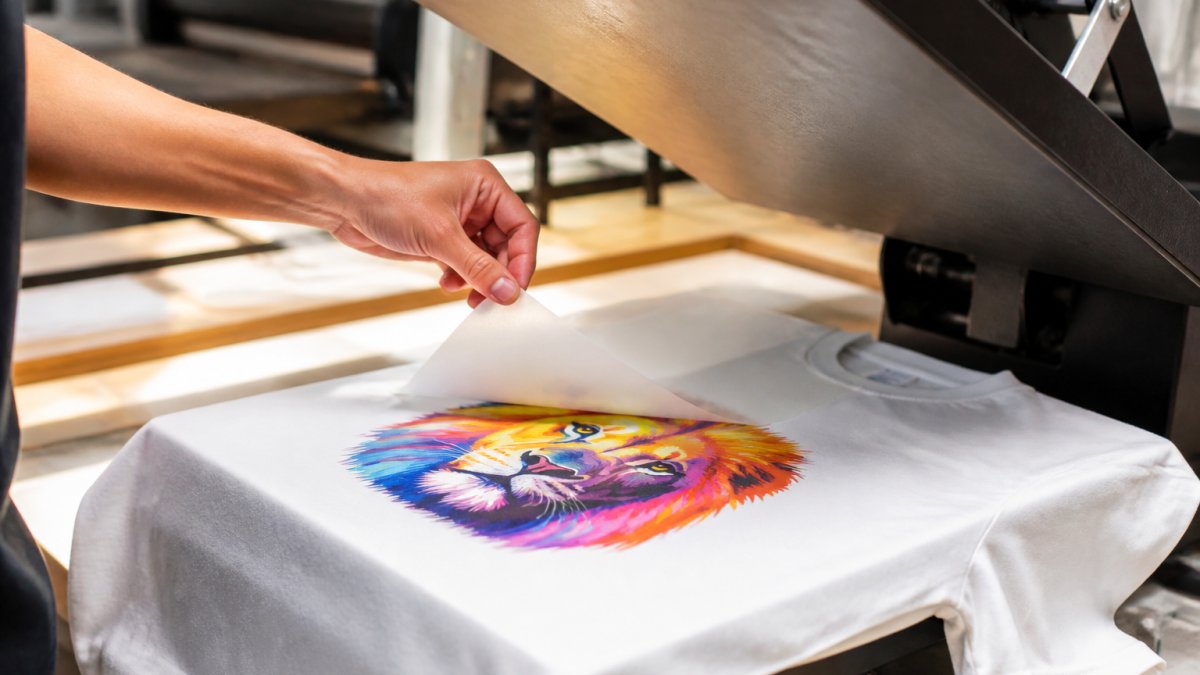
Temperature, Time, and Pressure by Material
Cotton requires 320-340°F for 10-15 seconds with medium pressure. Too hot and the fabric scorches. Too cool and the adhesive doesn't bond. Polyester needs slightly lower heat (300-320°F) because it melts easily.
Pressure must be firm but not crushing. The transfer needs full contact with the fabric, but excessive pressure damages the fabric or causes the transfer to slip. Most heat presses use a scale of 1-10.
Dwell time (how long you hold pressure) varies by transfer size and fabric weight. Small transfers on light cotton need 10 seconds. Large transfers on heavy hoodies need 15-20 seconds. Test on your specific combination.
Peel Method and Troubleshooting Common Issues
Peel the film while the transfer is still warm (not hot). Cold transfers are brittle and tear.
Adhesion problems mean the transfer doesn't stick to the fabric. This usually indicates low temperature or short dwell time.
Banding (horizontal lines across the transfer) indicates uneven pressure. The heat press isn't making full contact with the transfer.
Fading or color shift happens when temperature is too high. The ink breaks down or the colors separate.
The challenge is execution. Consistency, quality control, and proper pressing technique separate great results from disappointing ones.
| Factor | DTF Printing | Screen Printing |
|---|---|---|
| Setup Cost | None | $20-40 per screen |
| Minimum Order | 1 unit | 50+ units (economical) |
| Color Count | Unlimited | Per-color fee |
| Turnaround | 5-10 days | 7-14 days |
| Fine Detail | Excellent | Good |
| Per-Unit Cost (small order) | Lower | Higher |
| Per-Unit Cost (1,000+ units) | Higher | Lower |
Frequently Asked Questions
How much does DTF printing cost per transfer?
DTF printing cost varies based on design complexity, transfer size, order quantity, and delivery timeline. Pricing typically decreases with larger orders. For current pricing and a custom quote tailored to your specific needs, contact Mirage DTF Transfers directly through their secure platform. They can provide exact costs based on your promotional product specifications and volume requirements.
What are the main disadvantages of DTF printing compared to other methods?
DTF printing has some limitations: transfers require proper curing time before wear, adhesive powder can leave residue if not managed carefully, and durability depends on correct pressing temperature and time for each fabric type. Quality consistency requires careful file preparation and supplier reliability. However, DTF excels at full-color prints with no setup fees and low minimums, making trade-offs worthwhile for many promotional product businesses.
Is DTF printing suitable for small orders of promotional merchandise?
Yes. DTF printing is ideal for small-batch orders because there are no minimum order quantities and no setup fees, unlike screen printing. This makes it perfect for one-person operations, small shops, and businesses testing new promotional product designs. You can order single transfers or a dozen without penalty, making DTF cost-effective for custom apparel and branded merchandise at any scale.
How does DTF printing compare with screen printing for promotional merchandise?
DTF printing offers faster turnaround, no setup costs, and superior full-color reproduction, making it ideal for complex logos and small orders. Screen printing is more economical for large runs (500+ units) and offers excellent durability on cotton. DTF works on polyester and blended fabrics better than screen printing and handles intricate detail well. Choose DTF for variety and speed; screen printing for high-volume, simple designs on natural fibers.