

Table of Contents
- Understanding DTF Transfer Pricing Per Square Inch
- Factors That Influence DTF Production Costs
- DTF Gang Sheet Pricing and Waste Optimization
- Calculating Profit Margins on DTF Transfers
- Using a DTF Profit Calculator for Cost Analysis
- How to Price Custom Apparel With DTF Transfers
- Frequently Asked Questions
Last Updated: September 25, 2026
Understanding DTF Transfer Pricing Per Square Inch
DTF transfer pricing per square inch breaks down your total production expenses into a unit cost that scales with design size, making it easier to quote jobs accurately and maintain consistent margins across orders of different dimensions.
The square inch pricing model accounts for the primary variable in DTF production: film consumption. A 4x4 inch design uses roughly half the film of an 8x8 inch design, so per-square-inch pricing captures this relationship directly and beats flat-rate models that either leave money on the table or overprice.
Factors That Influence DTF Production Costs
Your per-square-inch cost shifts based on ink consumption, film waste, labor intensity, specialty material premiums, and overhead allocation. Understanding these variables separates shops that scale profitably from those that watch margins collapse.
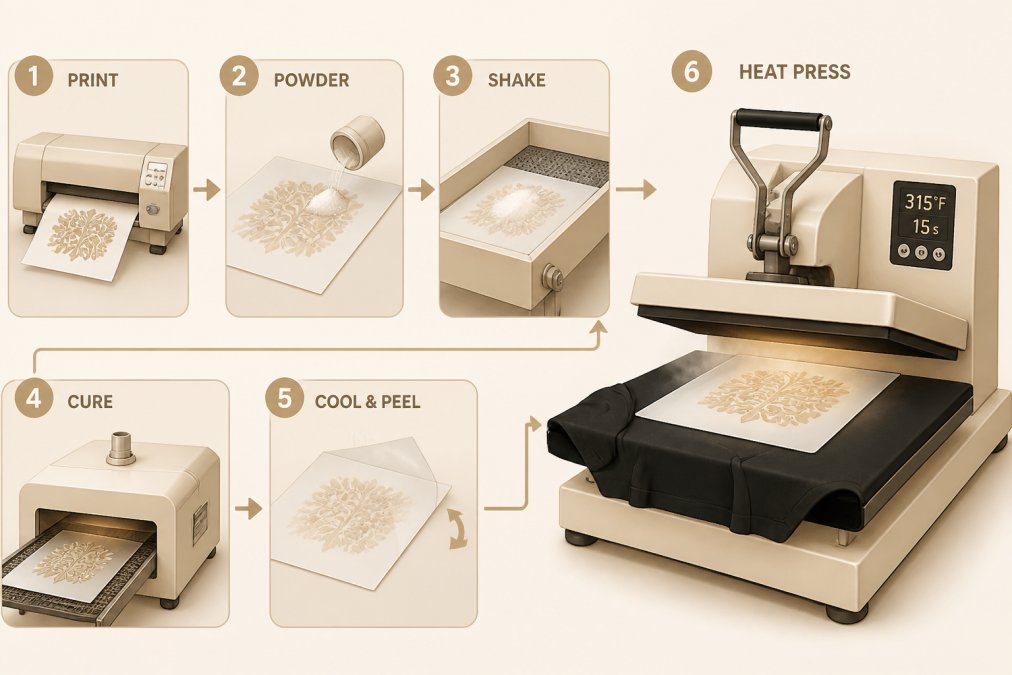
Ink Consumption and Film Waste
Ink consumption drives a significant portion of variable costs. Full-color designs with dense coverage consume more ink than spot-color designs. Many shops miss an opportunity by not adjusting pricing based on color complexity or ink density.
DTF ink costs $40-$80 per liter. A 4x4 inch design with 60% coverage consumes 0.5-1 milliliter; a 10x10 inch photorealistic design with 90% coverage consumes 3-5 milliliters. Track actual ink consumption over 50+ runs and adjust your per-square-inch rate for high-coverage work.
Film waste is the hidden cost that catches everyone. A well-optimized gang sheet wastes 10-15% of film; a poorly planned one wastes 30% or more. The difference between efficient and sloppy layout is real profit margin.
Calculate your waste ratio by dividing total film purchased by total usable transfers produced. Most shops discover their waste ratio is 20-35% higher than estimated, making true material cost per square inch significantly higher than raw film price.
Specialty Ink Cost Adjustments
Specialty inks command material cost premiums: neon and fluorescent cost 40-60% more; metallic inks run 50-80% premiums; glow-in-the-dark costs 2-3x standard ink. Adjust your per-square-inch pricing for specialty work or you'll subsidize it with margin from standard orders.
Create separate pricing tiers for specialty ink work. A standard CMYK 4x4 inch design might be $2.00; neon $2.80-$3.20; metallic $3.00-$3.60; glow-in-the-dark $4.00-$6.00. Track specialty ink usage for 2-3 months to establish your true cost baseline.
Labor Intensity and Setup Fees
Labor cost per transfer varies based on design complexity and order size. A 500-unit order spreads setup time across 500 pieces; a custom order of 10 different designs has 10 times the setup burden. Many shops charge setup fees separately or require minimum order quantities.
Equipment Depreciation and Overhead
Your DTF printer, heat press, and curing oven represent capital costs that must be recovered through pricing. A DTF printer typically depreciates over 5-7 years, so you carry monthly depreciation costs regardless of volume.
Overhead, facility rent, utilities, insurance, software subscriptions, must be factored into your per-square-inch cost by dividing total monthly overhead by total square inches produced. This cost per square inch decreases as volume increases.
DTF Gang Sheet Pricing and Waste Optimization
Gang sheet optimization separates experienced shops from beginners. A gang sheet is a single piece of film containing multiple designs. The goal is to minimize waste while maximizing transfers per sheet, which directly impacts your per-square-inch cost.
The Economics of Gang Sheet Layout
More designs per sheet means lower film cost per transfer. A standard 13x19 inch sheet provides 247 square inches, but usable design area is typically 200-220 square inches after accounting for printer margins and gaps between designs.
Designs averaging 20 square inches each could fit 10-11 per sheet perfectly; in practice, most shops achieve 7-9 due to irregular shapes. The difference between 7 and 9 designs per sheet is 28% more output from the same film cost.
Calculate your current gang sheet efficiency by tracking: (Total square inches of designs printed) ÷ (Total square inches of film purchased) × 100. Most shops discover their efficiency is 55-70%. Industry leaders operate at 75-85%. The 15-20 percentage point gap represents pure margin opportunity.
Nesting Software and Waste Reduction
Manual gang sheet layout limits efficiency to 65-70%; software-based nesting delivers 75-85%. Tools like Inkscape with nesting plugins or specialized DTF software automate the process.
The workflow: import designs, set sheet dimensions and margins, run the nesting algorithm, review for spacing issues, make adjustments if needed, and export.
Most nesting software can process 20-50 designs in under 5 minutes. The time investment is minimal compared to the waste reduction. If nesting software improves your efficiency from 65% to 78%, and you're printing 1,000 sheets per month at $8-$12 per sheet in film cost, you're recovering $1,040-$1,560 per month in material costs. That's $12,480-$18,720 annually from a one-time software investment of $200-$500.
Waste-to-Cost Conversion Framework
To price gang sheet optimization into your per-square-inch cost, you need to convert waste percentage into actual dollars. Here's the framework:
Step 1: Calculate your film cost per square inch. If a 13x19 inch sheet costs $10 and provides 220 usable square inches, your raw film cost is $0.045 per square inch.
Step 2: Measure your current waste ratio. If you're achieving 65% efficiency, you're wasting 35% of purchased film. Your true material cost per square inch of produced transfer is: $0.045 ÷ 0.65 = $0.069 per square inch.
Step 3: Project the impact of improved nesting. If you improve to 78% efficiency, your true material cost drops to: $0.045 ÷ 0.78 = $0.058 per square inch. That's a $0.011 per square inch reduction, or roughly 16% lower material cost.
Step 4: Apply this to your pricing. If you're currently charging $0.40 per square inch and your material cost is $0.069, your material margin is $0.331. After improving nesting, your material cost drops to $0.058, and your margin expands to $0.342. You can either pocket the extra $0.011 per square inch or pass some of it to customers as a competitive advantage.
Batch Size and Gang Sheet Efficiency
Gang sheet efficiency also depends on batch size. A 50-unit order of the same design is easy to nest; you're repeating one design 50 times on multiple sheets. A 50-unit order of 50 different custom designs is a nesting nightmare; you have 50 unique shapes to fit together, and efficiency drops significantly.
For custom orders with high design variety, consider charging a "nesting complexity fee" of $5-$15 per order, or building it into your setup fee.
Calculating Profit Margins on DTF Transfers
Your profit margin on a transfer is the difference between what you charge and what it costs you to produce. The challenge is accounting for all costs, not just the obvious ones like ink and film.
Using a DTF Profit Calculator for Cost Analysis
A DTF profit calculator automates the math and forces you to think through all the variables. The best calculators let you input your actual costs, what you pay for ink per liter, film per roll, labor per hour, and then calculate your per-square-inch cost and suggested retail pricing.
How to Price Custom Apparel With DTF Transfers
Pricing custom apparel orders requires more than just multiplying square inches by your per-square-inch cost. You need to account for order complexity, customization, and market positioning.
Tiered Pricing vs. Flat Rate Models
Tiered pricing sets different per-square-inch rates based on order volume. A 50-unit order might be $0.50 per square inch. A 500-unit order might be $0.35 per square inch. This rewards bulk orders and reflects your actual cost structure, larger orders have lower overhead per unit.
Volume Discounts and Retail Rate Strategy
Volume discounts are standard in the industry. They incentivize larger orders, which improve your per-unit profitability due to lower setup costs and better gang sheet efficiency.
Frequently Asked Questions
How much should I charge per square inch for DTF transfers?
DTF transfer pricing depends on design complexity, order volume, and your production overhead. Most shops calculate cost per square inch by dividing total production costs (ink, film, powder, labor, equipment depreciation) by the number of square inches produced. From there, apply your target profit margin, typically 50-100% markup over production cost. Pricing varies by supplier and order size, so request a quote from your DTF transfer provider for current rates based on your specific volume and requirements.
What is a gang sheet and how does it affect DTF pricing?
A gang sheet consolidates multiple designs onto a single film before cutting and application, maximizing film usage and reducing waste. Efficient gang sheet layout directly lowers your cost per square inch by minimizing scrap material. Better gang sheet optimization means higher profit margins on the same transfer. When evaluating DTF gang sheet pricing, consider how your provider arranges designs, tighter nesting saves material cost and improves your bottom line on bulk orders.
How do I calculate profit margins on custom apparel orders?
Subtract your total production cost per unit from your selling price, then divide by the selling price and multiply by 100. For example, if a DTF transfer costs $2 to produce and you sell it for $5, your profit margin is 60%. Track all costs: ink consumption, film, adhesive powder, labor, heat press curing time, and equipment depreciation. Use a DTF profit calculator to model different order sizes and design complexities, since larger orders spread fixed costs across more units, improving margins.
What's the difference between tiered pricing and flat rate models for DTF transfers?
Tiered pricing charges different rates based on order volume or design complexity, larger orders cost less per square inch because fixed costs distribute across more units. Flat rate pricing charges the same price regardless of volume, which simplifies ordering but may leave money on the table for high-volume customers. Most profitable shops use tiered brackets that reward bulk orders while maintaining healthy margins on small custom jobs. Choose the model that matches your target customer base and production capacity.